

Building a marketing team starts with the same goal: bringing together talent to help your business attract customers, build trust, and turn interest into revenue. However, building that team in person and doing it remotely requires a shift.
Picture a marketing lead, a coordinator, and a part-time designer sharing a corner of an office. On Monday, the founder walks past and says the spring promotion should go out earlier this year. The lead nods. Nothing gets written down, but everyone knows what to do. The coordinator knows which customer list to use. The designer knows the logo can’t sit on red. Questions get answered across a desk, and work moves forward.
A remote team loses some of that convenience – after more than ten years leading marketing teams in both in-person and digital settings, I’ve learned that making it work takes more than moving office routines online – and the reason is simple: writing down a request takes more effort than mentioning it in passing, and building remote relationships takes deliberate attention.
Here’s how I approach building a remote marketing team with the talent, direction, and ways of working to support a growing business.
1. Start with the work that keeps getting stuck
Before choosing a role, decide what marketing needs to accomplish over the next 90 days. “Improve our marketing” leaves too much open to interpretation. “Generate more estimate requests for our commercial services” gives the team a customer group, an offer, and a result to work toward.
Asking where the work stalls today can also tell you which role comes first.
| What’s happening | Role to consider |
|---|---|
| Nobody can explain what marketing should accomplish next quarter | Marketing leader or strategic advisor |
| Campaigns are planned, but deadlines keep slipping | Marketing coordinator |
| The direction is clear, but content isn’t getting produced | Content specialist |
| A specific channel needs more attention or expertise | A specialist for that channel |
If there are campaigns planned but nothing goes out on time, a coordinator may be the right addition. If the plan is clear but the content isn’t good enough, you need a specialist. If nobody can explain what marketing should deliver this quarter, someone needs to set direction before you add people to carry it out.
2. Choose people who can explain their thinking and work independently
Remote work isn’t going anywhere. By 2030, around 92 million global digital roles will be performed remotely. Now, building a team that works this way calls for people who share their thinking openly: when they spot a problem, need a decision, or see a better approach. Those conversations are less likely to happen by chance when you aren’t sharing an office, so communication and autonomy need to become part of how the team works.
In interviews, ask candidates to walk you through one piece of past work:
- The audience.
- The goal.
- What they changed after reviewing results.
A short written task may also help you look at how clearly they explain their choices. Someone who can describe why they changed an email’s message gives me more to assess than a polished email alone.
Ask about the environment they’ve worked in, too. A person who has always had established processes and close supervision may need support in a remote capacity or in a business still building its marketing function. Make sure the independence you expect matches their experience.
3. Use the first month to give them context
The first week of any hire should be about making relevant information available. Walk them through your services, your best customers, and why people choose your business. Explain the questions and objections that come up before someone buys.
You can start by sharing a reference folder with brand guidelines, approved examples, customer insights, and the current marketing plan. Also, include unwritten rules: preferences and restrictions that existing team members know but a newcomer would have no way to discover, plus individual tool accounts and access needed to complete their assignments.
Then start with one defined project, such as an email campaign for a service they’ve just learned about. Review it together and explain your feedback in writing. If a phrase misrepresents the service, explain why, so they can use that judgment next time. By day 30, they should understand what good work looks like in your business and where to go when they need help.
4. Make (good) communication the backbone of your day-to-day
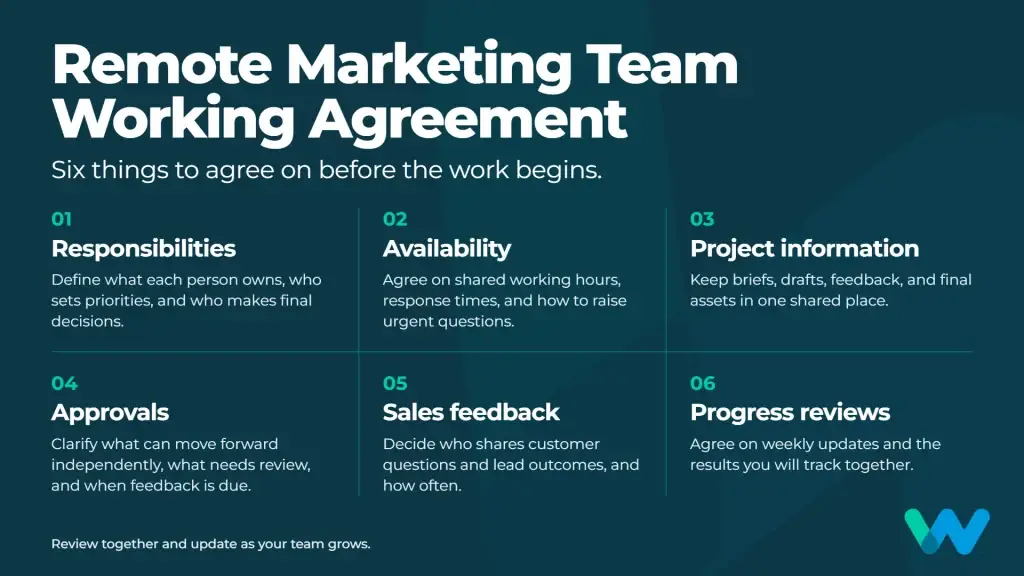
A remote team doesn’t need to be in constant conversation, but people do need to know when they can reach one another and how to raise something that can’t wait.
Use one shared place to track assignments, deadlines, feedback, and approvals. An email campaign, for example, should have its brief, draft, reviewer, and due date together. The person preparing it shouldn’t have to search through private messages to find the latest decision.
Keep routine updates in writing and use a short weekly meeting for priorities, results, and blockers that need discussion. Written updates let people check progress while meetings are useful when a conversation can resolve something faster than a round of messages.
5. Establish an approval hierarchy
There’s a reason why everyone loves org charts: they represent hierarchy (you should question yourself if that’s the case), some people love them because they provide workplace clarity, I love them because, if well designed, they should represent how information flows.
According to Sara Hallam, the world’s first org chart was a tree. The tree worked because it moved information up and down the company.
Remote teams move information differently: through shared docs, chat, and the CRM. Across time zones, a question that climbs three levels of approval can cost a full day.
That’s the case for rethinking your approval hierarchy and setting approval boundaries. Work that uses approved messaging can move forward independently while pricing changes, new offers, and changes to how the business is positioned need the owner’s input. Put a deadline on those decisions so completed work doesn’t sit for days waiting for an answer.

6. Give marketing access to what sales is learning
A marketing team can see inquiries coming in and still have an incomplete picture of whether its work is helping. It needs to know what happens after those inquiries reach sales.
Ask the people who talks to prospects to share questions buyers ask, objections that stall decisions, and which leads turn out to be a good fit. If a campaign produces inquiries from people looking for a service you don’t offer, marketing needs to hear that. Otherwise, the team may keep promoting a message that appears to be working.
That exchange should go both ways. Marketing should tell sales what’s running, who it’s intended to reach, and what’s coming next.
7. Measure early progress and business results
Choose a few measures tied to the quarterly goal. For a service business, those might include qualified inquiries or booked jobs. Track early signs of progress as well, including whether campaigns go out on schedule, how people respond, and whether the leads fit your services.
These measures answer different questions. A campaign can generate suitable inquiries before those prospects are ready to book. Equally, a full publishing calendar tells you little about whether the work is reaching the right people. Review both delivery and customer response, then follow the leads through to the outcome. Revenue and booked jobs can take longer to show up, so don’t judge a new team solely on those results too early.
8. Check the workload before adding another person
Finally, consider adding someone when the work is clearly defined, priorities are settled, and the workload consistently exceeds what the current team can handle. If assignments keep changing or finished work waits days for approval, another person won’t resolve the cause of the delay.
Ask whether the team could manage the work with clearer priorities and a better process. If the answer is still no, look at what keeps slipping.
The lesson to keep coming back to is: teams depend on what’s written. When goals, standards, and decisions stay in people’s heads, someone always has to stop and explain them. Recording that knowledge helps a new person get up to speed and lets the team keep working when someone is out. It also gives you a stronger foundation for the next person you bring in.
If you’re ready to build your remote marketing team, start with the responsibility you want someone to take on, and build from there.

 Summarize this article with: